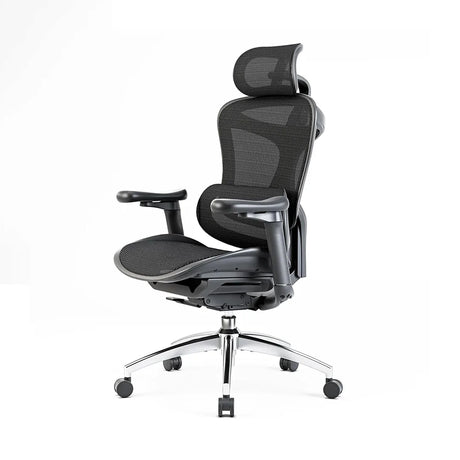
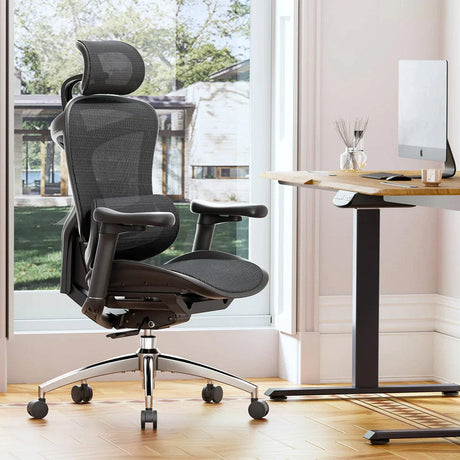
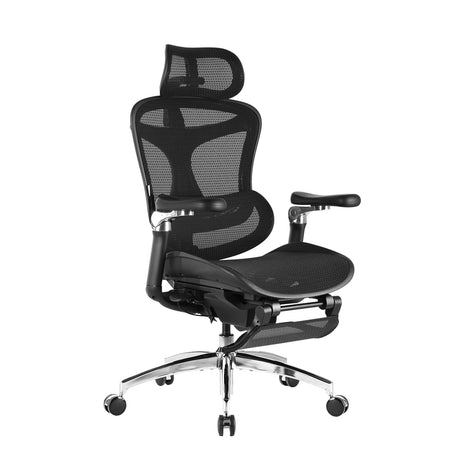
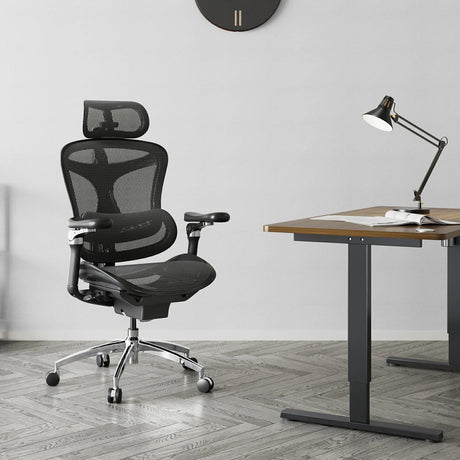
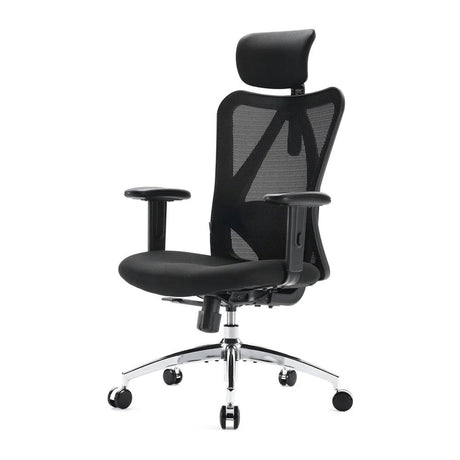
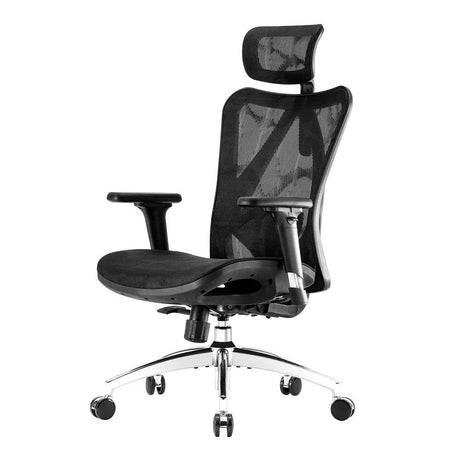
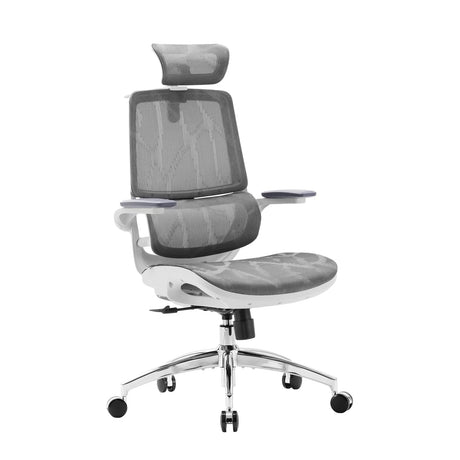
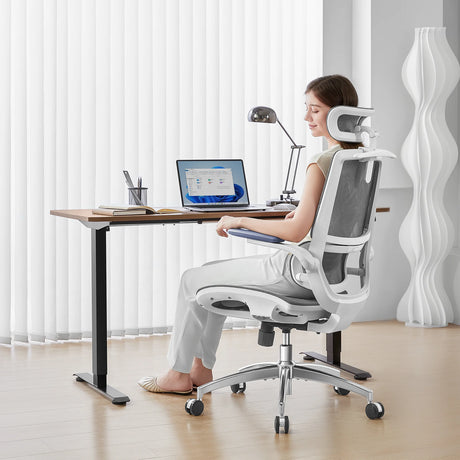
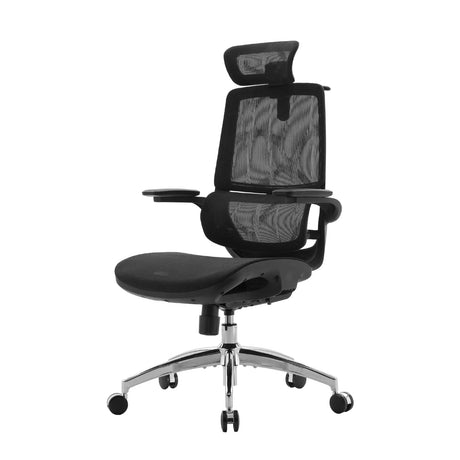
The Sihoo Doro C300 Pro V2 reflects our idea of what a modern ergonomic chair should be: technically refined, precisely adjustable, and built to support the body not only in an ideal sitting posture, but throughout real movement during everyday use. With 8 core features and 14 adjustment options, it was developed as an integrated system in which the backrest, lumbar support, mechanism, headrest, armrests, seat, and materials all work together with purpose.
For us, ergonomics is not about stacking features on a spec sheet. What matters is how a chair performs in real use: when sitting upright, when reclining, during small posture shifts, and over long hours of sitting. That is exactly why we designed the Doro C300 Pro V2 not as a collection of isolated comfort features, but as a coordinated ergonomic system with clearly defined mechanical and support functions.
Key Features at a Glance
| Feature | Key Detail |
|---|---|
| SyncroFlex Lumbar-Back Gliding Technology | Dual-rail, dual-spring structure with locking function, designed to follow the sacral curve dynamically |
| Smart Weight-Sensing Mechanism | Automatically adjusts recline resistance based on body weight |
| Domino 2nd-Generation Lumbar Support System | Independent height-adjustable lumbar support with a wide contact area and adaptive support during recline |
| Wide Mechanical Headrest | Height, rotation, and depth adjustment with automatic locking and a 28% larger support area |
| 8D Synchronized Armrests | Adjustment in 8 dimensions, including synchronized movement in recline and extended rear support |
| Cloud Mesh 2.0 | Technical mesh made with DuPont elastomer and polyamide fibers in a specialized weave |
| Flexibly Tracking Backrest | Dynamic back support with 6 cm height adjustment |
| Pressure-Balancing Sliding Seat | Enlarged and deepened seat design for more even pressure distribution |
| 105°–135° Recline | Multi-angle recline for work, relaxation, and rest |
| Retractable Rotating Footrest | Additional leg support with breathable mesh construction |
| Class 4 Gas Lift | 2.5 mm inner wall thickness, over 99% inert gas purity, tested for more than 120,000 cycles |
| Nylon Back Frame | Structurally stable, wear-resistant, and mechanically durable |
| Aluminum Base and PU Casters | Stable base, quieter movement, and better floor compatibility |
| Cable Control System | Direct access to key adjustment functions |
SyncroFlex Lumbar-Back Gliding Technology
The SyncroFlex system is one of the defining engineering features of the Doro C300 Pro V2. The lumbar-back unit is built on a movable structure with dual rails, dual springs, and a locking function. As the user reclines, the backrest glides in a controlled way and follows the sacral curve instead of allowing the lower back to lose contact.
This is where we see a clear difference from many conventional chair designs. In many cases, support in the lumbosacral area decreases as the recline angle increases. The SyncroFlex gliding structure is designed to compensate for the space that forms in this area, so lumbar support stays engaged and stable even while leaning back.

Smart Weight-Sensing Mechanism
The Smart weight-sensing mechanism automatically adjusts recline resistance based on the user’s body weight. That means the backrest does not respond the same way for every person, but adapts to the actual load placed on the chair.
The effect is easy to feel in everyday use. Reclining feels smoother and more controlled, while returning upright feels more balanced. For us, this is not a secondary detail. It is a core part of an ergonomic chair that should feel natural and consistent every time it is used.

Domino 2nd-Generation Lumbar Support System
The Domino 2nd-generation lumbar support system is built as an independent height-adjustable lumbar unit. Its broad horizontal support surface increases contact with the lower back and delivers more targeted lumbar support.
What matters even more is how it behaves in motion. During recline, the lumbar support follows the lower back automatically and stays in contact instead of leaving the lumbar area unsupported. In our view, lumbar support needs to remain effective in reclined positions, because that is exactly where many standard systems lose precision.

Wide Mechanical Headrest
The mechanical headrest offers height, rotation, and depth adjustment. With these three adjustment directions, it can be positioned more precisely for different sitting postures than simpler headrest designs with more limited movement.
It also features a larger support area. According to our specifications, the contact surface is 28% larger than typical market alternatives. This creates a broader and more stable support zone for the head and neck. For us, it was important that the headrest not only work in reclined positions, but also remain genuinely useful when sitting upright.

8D Synchronized Armrests
The 8D armrests adjust in eight dimensions: height, depth, width, inward and outward positioning, rotation, angle, synchronized recline movement, and extended rear support.
This configuration makes a real difference in daily use. The forearms stay supported in more seating positions, and support is better maintained even during recline. The extended rear support is especially important because it helps reduce arm slippage when leaning back. For us, armrests are not secondary features. They are part of the structural foundation of an ergonomic seating system.

Cloud Mesh 2.0
Cloud Mesh 2.0 combines DuPont elastomer, polyamide fibers, and a specialized woven structure. Compared with the previous generation, the weave density has been increased to improve resilience, shape retention, and durability.
This material choice follows a clear principle: mesh should not only be breathable, but also remain elastic, tensile, and wear-resistant over time. That is exactly what we expect from a premium material system. Cloud Mesh 2.0 is designed to retain both its structure and its support feel through repeated daily use.

Flexibly Tracking Backrest
The backrest is flexibly mounted and height-adjustable by 6 cm. It responds to posture changes and follows upper-body movement dynamically instead of staying fixed in one rigid position.
This improves contact between the body and the backrest not only during recline, but also during small side-to-side movements. Support stays more even, and the shoulder area feels less strained. For us, this tracking movement is part of what defines a chair that adapts to the body rather than forcing the body to adapt to it.

Nylon Back Frame
The back frame is made from nylon, a technical structural material known for toughness, wear resistance, heat resistance, and mechanical stability. This material choice was deliberate, because the back structure needs to remain reliable over time.
According to our specifications, the frame has been tested for 120,000 load cycles. That reflects our intention to deliver not only comfort, but also long-term structural durability. In our view, that kind of construction reliability is a core part of high-quality ergonomics.

Pressure-Balancing Sliding Seat
The seat is enlarged, deepened, and designed as a pressure-balancing sliding seat. The goal is to distribute pressure more evenly, reducing concentration on the hips and thighs while helping stabilize the seating position.
This geometry also supports a wider range of users, including taller and broader body types. For us, seating comfort does not begin with softness alone, but with a seat structure that distributes weight, contact, and support in a smarter way.

105°–135° Recline
The backrest reclines to 105°, 120°, and 135°, covering both upright working positions and more relaxed seating postures.
What matters here is not only the angle itself, but the stability of movement throughout the recline range. Even at deeper recline angles, support remains controlled and secure. That is why we do not treat recline as an added comfort feature, but as an essential part of an ergonomic chair designed for different phases of use.

Retractable Rotating Footrest
The footrest is retractable, rotating, and flexibly adjustable. The mesh construction is breathable, easy to maintain, and designed for long-term use.
In reclined positions, it provides additional support for the legs and feet. This prevents the legs from hanging unsupported and makes the recline position feel more complete and more relaxed. For us, this is not merely an accessory, but a practical extension of full-body ergonomic support.

Class 4 Gas Lift
The integrated Class 4 gas lift has an inner wall thickness of 2.5 mm, above the common minimum standard of 2.0 mm. It uses inert gas with a purity level of over 99%.
It has also been tested for more than 120,000 load cycles. This improves stability, safety, and long-term reliability in height adjustment. Here as well, our position is clear: ergonomics does not end with visible comfort features, but includes the construction quality of the components underneath them.
Aluminum Base and PU Casters
The aluminum base provides a stable and durable platform for the chair as a whole. The PU casters offer quieter movement and are gentler on flooring than harder wheel materials.
On surfaces such as tile and wood flooring, that difference becomes clear in everyday use. At the same time, the caster construction is designed for long-term durability and high load tolerance. For us, this level of material and structural quality is part of what makes a chair dependable over time.
Cable Control System
The main adjustment functions are operated through a cable control system. This makes the key settings more directly accessible than on conventional lever-based systems with less intuitive layouts.
That simplifies operation and makes everyday adjustment faster and clearer. We wanted a solution that does not complicate functionality, but makes the chair easier to use and easier to fine-tune in real life.

Conclusion
The Sihoo Doro C300 Pro V2 has been designed as an ergonomic chair with both technical depth and real everyday relevance. In our view, what matters is not simply the number of functions available, but the way the different systems work together mechanically and ergonomically.
From SyncroFlex lumbar-back gliding and the Domino 2nd-generation lumbar support system to 8D synchronized armrests, Cloud Mesh 2.0, the pressure-balancing sliding seat, and the Smart weight-sensing mechanism, each core component has been developed to deliver support in a more precise, stable, and complete way. That is how we define the Doro C300 Pro V2: not as a chair with many features, but as a carefully developed ergonomic system.